Japan's Grid Plan Is Worth About 7 Trillion Yen. The First Big Wire Is Still on Paper.
Hokkaido has the wind, the land and now a 2nm fab. Tokyo has the demand. The link between them carries 900,000 kW today and 1.2 million kW from fiscal 2027. The 2 million kW undersea line meant to change that was still at the implementation-plan stage in June 2026.
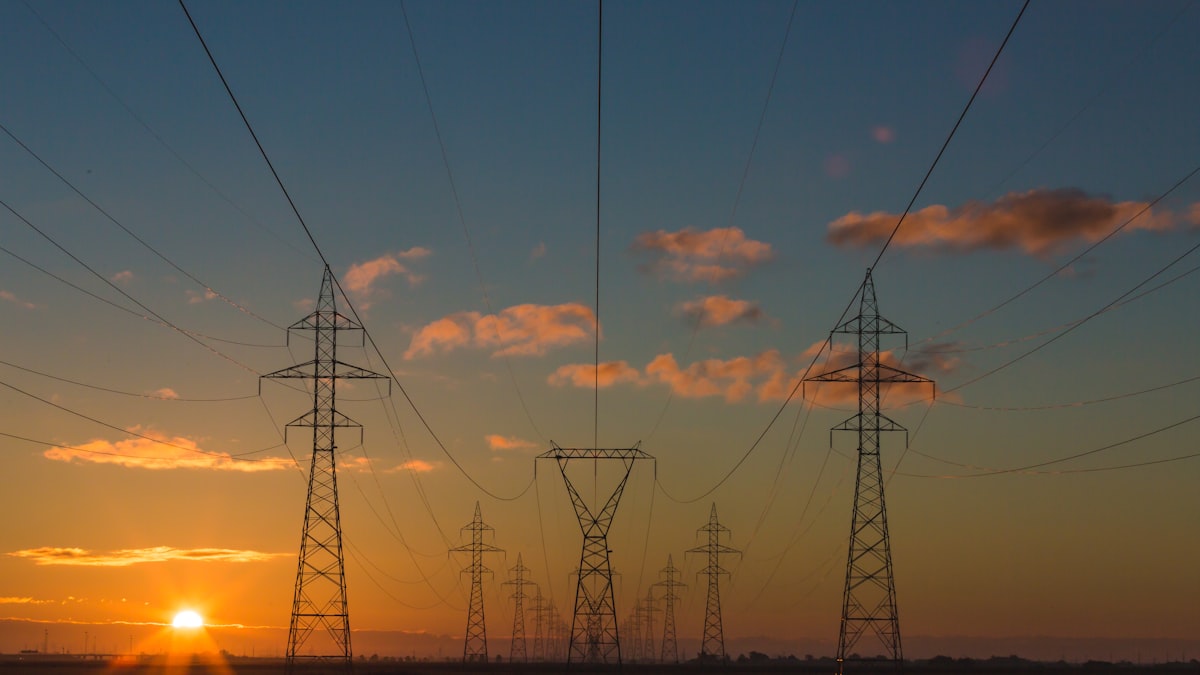
Japan’s renewable resource and Japan’s electricity demand are in different places, and have been for as long as anyone has been measuring either. Hokkaido and Tohoku have the wind, the land and the capacity factors. Tokyo has the load. Between them runs a set of interconnectors whose capacity decides how much of the first can ever reach the second.
The Hokkaido-Honshu link carries 900,000 kW today. A project to raise it to 1.2 million kW is due to finish at the end of fiscal 2027. The much larger undersea line that is supposed to change the picture properly was, as of June 2026, still being costed.
What the master plan actually says
The Organization for Cross-regional Coordination of Transmission Operators, OCCTO, published the Wide-Area Grid Long-Term Policy on 29 March 2023 (OCCTO, 29 March 2023). It is usually called the Master Plan, and it is the document every later project is measured against.
The summary OCCTO published alongside it states the conclusion this way, translated from the original: if renewables are to become the main source of power and the network is to be made resilient through grid reinforcement, it was possible to show that even with network investment on the order of 7 trillion yen, benefits exceeding that amount may be secured (OCCTO Master Plan summary, PDF).
What the 7 trillion yen does not cover
The same summary page carries three notes on what the 7 trillion yen covers.
The figure counts only the cost of reinforcing the wide-area network, the interconnectors and similar, needed to carry geographically concentrated generation to the big consumption areas. It explicitly does not include the cost of the countermeasures that more renewables create elsewhere in the system: securing balancing capability, and dealing with falling inertia and synchronising force.
The HVDC transmission costs use unit prices that already assume the economies of scale and technological cost reductions expected around 2050.
And submarine cable work excludes occupancy fees, with the note adding that route changes to account for water depth and similar factors may increase costs.
The first big wire: the Sea of Japan route
The flagship project is a new Hokkaido-Honshu interconnection running down the Sea of Japan side, usually called the Nihonkai route. OCCTO’s 102nd Wide-Area Grid Development Committee published a status report on it on 24 June 2026 (OCCTO, 24 June 2026, PDF).
The design is multi-terminal rather than point-to-point. New self-commutated converter stations at Shiribeshi in Hokkaido, Akita, and Niigata, each with converter equipment rated 1 million kW and plus or minus 330,000 kvar per pole, times two.
The link itself is a plus or minus 525 kV bipolar single-circuit 2 million kW DC submarine cable, in two legs: roughly 460 km from Shiribeshi to Akita, and roughly 300 km from Akita to Niigata. Short DC underground sections connect the landing points to the converter stations, about 2 km at Shiribeshi, about 3 km on each of two routes at Akita, and about 4 km at Niigata.
The AC work that makes the DC line usable is listed separately: new 275 kV Shiribeshi and Donan access lines, new switching stations with six-circuit 275 kV connections, reconductoring of the Shiribeshi trunk line, a new 500 kV Akita access line, a pi-connection into the 500 kV Minami-Niigata trunk, and an upgrade at Kawabe substation.
Where it had got to in June 2026
Four qualified operators are doing the work: Hokkaido Electric Power Network, Tohoku Electric Power Network, TEPCO Power Grid, and J-Power Transmission and Transformation Network.
The June 2026 document is their fifth quarterly report under the tender terms. The operators are working on total project cost and the amount to be raised on the assumption of project finance, with stated assumptions about loan tenor, interest during construction, and fees, and they are refining those numbers through discussions with financial institutions. The financing approach is being developed with reference to a new national scheme, discussed in December 2025, for smoothing the delivery of large-scale grid development.
OCCTO, for its part, said it would evaluate construction cost and schedule as part of the preliminary evaluation, and that the operators had asked for that evaluation early, at the implementation-plan stage, so they could take the results into discussions with their lenders. OCCTO plans to commission an outside party with relevant expertise to assess the project-finance-specific costs.
The same document sets out the remaining sequence, carried over from the committee’s 99th meeting. The steps are calculating construction cost and schedule, studying the financing method, calculating total project cost, and then judging whether the twelve conditions attached at the time of application have been met, with the implementation-plan submission deadline at the end of that run. The marker for where the project stood sat partway along it.
The implementation plan had not yet been submitted. Construction cost and schedule were still to be evaluated. The design itself was also still moving: the Kawabe substation upgrade in the June 2026 works list is annotated as reflecting the verification subcommittee’s discussion, which is a change made to the specification after the project had been in detailed design for more than a year.
Meanwhile, the small upgrade
The near-term change is already decided. OCCTO’s plan for the existing Hokkaido-Honshu interconnection raises it by 300,000 kW, from 900,000 kW to 1.2 million kW, at an approximate total cost of 101.4 billion yen, split as roughly 47.9 billion yen of construction and 53.5 billion yen of operation and maintenance, with completion scheduled for the end of fiscal 2027 and Hokkaido Network and Tohoku Network as the delivery bodies (OCCTO, 8 March 2024, PDF).
The works behind that 300,000 kW are specific and unglamorous: new AC-DC converter equipment at the Hokuto and Imabetsu converter stations, additional 250 kV DC overhead transmission line on both the Hokkaido and Honshu sides, additional 250 kV DC underground line, partial reinforcement of the 275 kV Imabetsu trunk line, plus system modifications and common facilities. Note the split in the cost: 47.9 billion yen to build it and 53.5 billion yen to run and maintain it. More than half the approximate total is the cost of operating the asset, not the cost of putting it in.
Why this decides where things get built
If the wire out of Hokkaido is constrained, the alternative to moving electrons is moving the load: put the thing that consumes the power next to the power.
Rapidus built its 2nm pilot line at Chitose, and its packaging arm, Rapidus Chiplet Solutions, moved to full-scale prototype production of a 600mm-square RDL interposer panel in the same place in April 2026. Semiconductor fabrication and advanced packaging are both continuous, power-hungry processes.
A data centre can be built where the generation is, or where the users are, and transmission capacity is what sets the exchange rate between those two choices. When the interconnector is 900,000 kW, siting near the load and paying for power is rational. The calculation changes if and when 2 million kW of HVDC lands at Niigata.
The Master Plan prices cables at 2050 unit costs and excludes the balancing and inertia costs that come with the renewables it is built to carry. The first major project inside it is in its fifth quarterly report and has not yet had its construction cost evaluated.
At the Summit
Tech for Impact Summit 2027 is co-hosted by the United Nations University and held at its headquarters in Shibuya, Tokyo on 18 and 19 May 2027. Our energy and infrastructure sessions seat transmission planners, their financiers and the companies choosing sites at the same table.
The Summit is invitation-only. If you work on transmission, industrial siting, or the capital behind either, you can join the waitlist at tech4impactsummit.com/apply and we will be in touch.